|
Root Cause Failure Analysis
Root Cause Failure Analysis is an intense 2-day program that integrates Engineering, Quality Assurance, Manufacturing, Manufacturing Engineering, and Supply Chain efforts to identify and eliminate root failure causes occurring in complex systems, subsystems, and components. The approach relies on fault tree analysis for identifying all potential failure causes and an associated set of technologies for evaluating each hypothesized potential cause. Hardware analysis, statistical analysis, design of experiments technical data package evaluation, and other technologies are combined to provide an effective root cause failure analysis procedure for manufacturers, process industries, and other technology-based organizations.
We will tailor this training to your industry and your specific needs. This is not just another canned "make your problem fit our solution" training program. It may well be the most valuable training your organization ever receives.

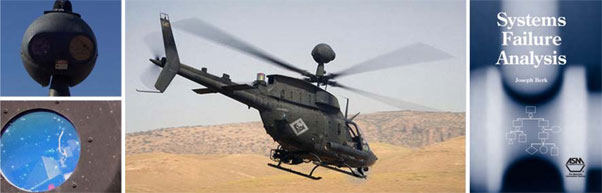
We literally "wrote the book" on root cause failure analysis (click on the photo to the right to order a copy) based on decades of experience...experience and knowledge you can put to work in your organization!
|
|
The Root Cause Failure Analysis program provides students with the ability to:
-
Identify dominant failure modes through quantity and cost-based Pareto analyses
-
Identify the root causes of systems failures
-
Select and implement effective corrective actions
-
Work as an inter-organizational, multi-disciplinary failure analysis team
Course prerequisites include a four-year technical degree or equivalent industrial experience in an engineering or manufacturing environment.
Industry-based case studies are utilized extensively in the Root Cause Failure Analysis program, and during the program students analyze failures occurring in their products.Clients recover their training investment prior to course completion as these failures are eliminated.
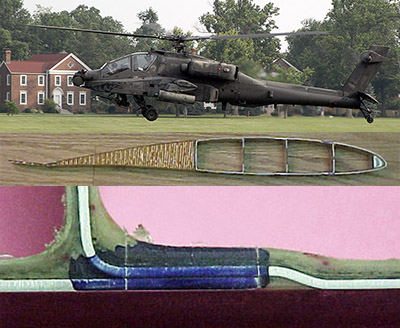
This helicopter blade experienced a 50% rejection rate and a short service life. Root Cause Failure Analysis techniques identified inadequate bondline width as the underlying cause. Tightened tolerances and tool control increased the yield to 100%.
|
|
Who Should Attend
Manufacturing engineers, quality engineers, project engineers, design engineers, MRB
engineers, procurement specialists, manufacturing managers, and program managers should attend this training.
Course Outline
-
Class1: Root Cause Failure Analysis Introduction. The need for efficient failure analysis. Failure analysis philosophy. The four-step problem solving approach. Systems and component failure analyses. The inherent value of failed hardware. Failure analysis definitions and basic failure analysis concepts.
Continuous improvement concepts and the systems failure analysis contribution. A framework for systems failure analysis. Quality measurement and reporting concepts. Nonconformance data base approaches. Pareto analysis. Integrating the cost of quality of program. Understanding systems interactions and how systems operate. The value of a priori failure cause identification. Case study assignment. Team assignment. Homework assignment related to in-house failure selection.
-
Class 2: Fault Tree Analysis Introduction. Fault tree analysis history and applications. Fault tree analysis capabilities. Fault tree analysis as the basis for further investigative work. Defining the problem and developing fault tree analysis top undesired events. Developing fault tree logic. Relationships between logic operators and events. Fault tree analysis symbology. And, or, and inhibit gates. Introduction to fault tree construction. Post-fault-tree fault isolation tools. Using Failure Mode Assessment and Assignment (FMA&A) matrices for managing the systems failure analysis effort. Computer-generated fault trees. Case study assignment. Team presentations. Homework assignment related to in-house failure analysis fault tree preparation.
-
Class 3: Fault Tree Analysis and Follow-On Assessments. Advanced fault tree construction. Gate usage and interpretation. Using inhibit functions to model probability distributions. Complex fault tree class exercises. Navigating from the failure site. Tips for identifying all potential failure causes. Probability and statistics applied to fault tree evaluations. Quantifying top undesired events. Failure rate sources. Using fault trees to identify redundancy-defeating failure modes. "What's Different" analysis. Use of test and inspection data, material certifications, and statistical process control data. Environmental effects. Use of flow charts for product performance and process evaluations. Interviewing techniques for use with assembly, test, and inspection personnel. Failed hardware analysis. Case study assignment. Team presentations. Homework assignment related to in-house FMA&A preparation.
-
Class 4: Design of Experiments and Systems Failure Analysis. Basic experimental design concepts. Deterministic versus statistical thinking. Hypothesis testing. The normal distribution and other basic statistical concepts. Analysis of variance. Z-tests, t-tests, and f-tests. Identifying potentially critical design and process parameters. Identifying test objectives. Test readiness reviews. Inducing failures to confirm causes. Introduction to Taguchi philosophies and Taguchi design of experiment technologies. Designing a Taguchi experiment. Selecting test parameters. Two and three level orthogonal arrays. Selecting output parameters and data collection approaches. Strategies for minimizing test risk. Signal-to-noise ratios. Defining test specimen configurations. ANOVA applied to Taguchi experiments. Typical test strategies. Multiple level experiments. Case study
assignment. Team presentations. Homework assignment related to in-house failure analysis.
-
Class 5: Additional Specialty Analyses. Evaluating failed hardware compliance. Assessing technical data package adequacy. Evaluating system/subsystem/component interfaces and requirements flowdown adequacy. The nature of build-to-print and “black box” procurements. Common technical data package shortfalls. Quality Assurance compliance assessment tools. Optical microscopy, SEM, FTIR, EDAX, X-ray, N-ray, SIMS, and Auger analysis. Tolerance analysis. Sneak circuit analysis. Monte Carlo simulations. Evaluating leaks. Basic metallurgical and electronic component evaluations. Failure analysis of vendor-supplied items. Customer/supplier interface issues. Commercial failure analysis laboratories. Other specialized analysis approaches. Case study assignment. Team presentations. Homework assignment related to in-house failure analysis.
-
Class 6: Corrective Action and Course Wrap Up. Dispositioning nonconforming material and the material review process. Common material review errors. The advantages of eliminating repair, rework, and use as is dispositions. Corrective action order of precedence. Advantages and disadvantages of design modifications, process modifications, procedural modifications, requirements relaxation, screening, and other potential corrective actions. Use of statistical process control as a corrective action. Evaluating corrective action effectiveness. Use of the FMA&A matrix for corrective action identification and tracking. Suggested failure analysis reporting format. Building a product-oriented failure analysis library and data base. Utilizing evolutionary product development learning opportunities. Creating a product-oriented Lessons Learned document. Course overview and summary. A suggested failure analysis procedure.
The above training can be customized to meet your requirements. Any questions? Please call us at 909 204 9984 or contact us via email.
|