Manufacturing Training Seminars

Proven Training, Expert Instructors, Focused and Measurable Results


Home
Certified Operator
Lean Manufacturing
Failure Analysis
Root Cause Analysis
Quality Management
Quality Function Deployment
Industrial Statistics
Supervision
Risk Management
Project Management
Presentations
Cost Reduction
Blueprint Reading
Engineering Economics
Client Comments

J.H. Berk and Associates

Contact Us

Cost Reduction

Cost reduction is an objective many organizations include in their annual plans, but few people have been trained to efficiently target and realize cost reduction opportunities.   The Cost Reduction training program develops an approach for systematically reducing costs. The program identifies cost reduction opportunities in the areas of: 

  • Material usage.

  • Scrap reduction.

  • Packaging improvements.

  • Assembly aids.

  • Process improvements.

  • Enhanced procurement philosophies.

  • Product design simplifications.

  • Transportation improvements.

  • Inspection and test redesign.

  • Improved warranty designs.

  • Material and paperwork movement reductions.

  • Inventory reduction.

  • Productivity improvement.

Course Materials
Who Should Attend

Engineers, manufacturing engineers, program managers, product line managers, buyers, and manufacturing managers should attend this training.

Cost Reduction Syllabus

  • Class 1:  Identifying Cost and Cost Reduction Opportunities.  Cost and accounting data.  Productivity data.  Assessing headcount.  Assessing material costs.  Identifying dominant costs and cost reduction targets.  Cost Pareto analysis from material, organization, and buyer/supplier perspectives.  Class exercise.

  • Class 2:  Value Engineering Concepts.  Assessing functions and design requirements.  Using substitute materials.  Product simplification concepts.  Assessing design and quality requirements internally, at suppliers, and at the customer.  Class exercise.

  • Class 3:  Materiel Opportunities.  Make or buy considerations.  Assessing work allocation.  Controlling supplier cost growth.  Identifying Procurement cost reduction opportunities.  Soliciting supplier involvement.   Competition versus teaming.  Assessing and reducing WIP and raw material inventory levels.  Class exercise.

  • Class 4:  Manufacturing Opportunities.  Labor standards and productivity measurement.  Implementing reasonable expectations.  Learning curves.  Process yield targeting.  Assembly aids.  Using quality assurance data to focus cost reduction efforts.  MRB and MRP considerations.  Class exercise.

  • Class 5:  Quality Assurance Opportunities.  Inspection point selection issues.  Consumer and producer risk.  Statistical process control considerations.  Dock-to-stock issues.  Certified operator programs.  Using quality assurance data.  Class exercise. Course summary.  Course critique.


The above training can be customized to meet your requirements.

Need a guest speaker for an important luncheon or dinner meeting?  Please contact us.

Any questions?  Please call us at 909 204 9984 or contact us via e-mail.

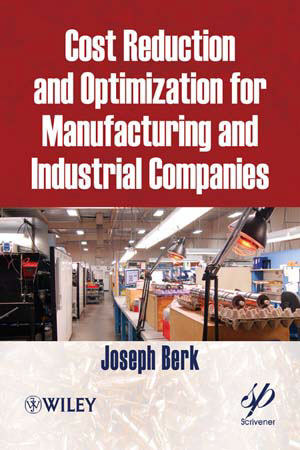
An unending focus on cost reduction is what makes businesses survive and thrive in good times and bad.  Our newest book, Cost Reduction and Optimization for Manufacturing and Industrial Companies, was published in January 2009 by Scrivener Publishing and Wiley.  This is a hands-on, no baloney, rapid road map approach for any organization interested in identifying and acting on cost reduction opportunities.  The book focuses on design, process, supplier, and overhead areas.   In addition to providing roadmaps in each area, this book identifies the risks (and actions to control risk) for each recommendation. As an added feature, Excel templates for the quantitative assessment techniques included with this book can be downloaded here.  (If you need help with this template, just give us a call at 909 204 9984.)
One of our key training areas (and the one we built the business on) is failure analysis.  We know what it's like when recurring failures add cost to the operation and you have to find the right fix quickly.   We also know what it's like when a failure shuts the operation down or prevents clients from using your product.  

ASM International published our latest work, Systems Failure Analysis, in December 2009, and you can order a copy here.  This is a great book based on actual experience in manufacturing environments, with a focus on finding and fixing root causes of complex systems failures.   Our Failure Analysis and Root Cause Analysis training programs use the approaches and technologies described in Systems Failure Analysis because they work, as many satisfied clients will attest.

Quality Management for the Technology Sector focuses on implementing quality management techniques with proven track records.  This 1-day seminar focuses on quality measurement, root cause corrective action techniques (including FMEA, FTA, and SFA), defining customer expectations (including QFD), using statistical techniques (including SPC and DOE), supplier teaming, and the latest quality standards (including ISO 9001:2000).  The program is based on Quality Management for the Technology Sector (Butterworth-Heinemann, 2002), our hands-on, practical guide to implementing effective quality management tools.

I would highly recommend this book not just to quality assurance professionals, but to professionals in all disciplines. - John W. Gozza, Quality Assurance Manager, Composite Structures LLC

Have a new management assignment, or know someone who recently was promoted into one?  Check out our book that provides guidance for new managers, A Handbook for First Time Managers.

Hit Counter